

GUIDING YOU THROUGH FLORIDA PROBATE WITH CARE AND EXPERTISE

We Understand Your Loss
If you are here to learn about the probate process after the passing of a loved one, we want to express our deepest condolences. Losing a loved one is never easy. The inheritance process can feel overwhelming.
Our goal is to simplify the legal and administrative challenges you may face during this difficult time. We guide you step by step through the probate process.
Even if an estate seems straightforward, issues can still arise. Common problems include:
-
Filing errors
-
Missed deadlines
-
Delays in the probate process
-
Additional costs
-
Family disputes or disagreements

These issues can create unnecessary stress during an already difficult time.
Our probate attorneys work to ensure every step complies with Florida law. This helps provide peace of mind and protects your loved one’s legacy.
Our Florida probate attorneys have over 20 years of experience and assist families across Orlando, Oviedo, and throughout the 67 counties in the state of Florida, ensuring your loved one’s estate is handled with care, clarity, and professionalism.
We understand you have lots of questions—and that’s completely normal!
The quickest way to get the answers you need is to schedule a free discovery call with our team.



Overview of the Probate Process
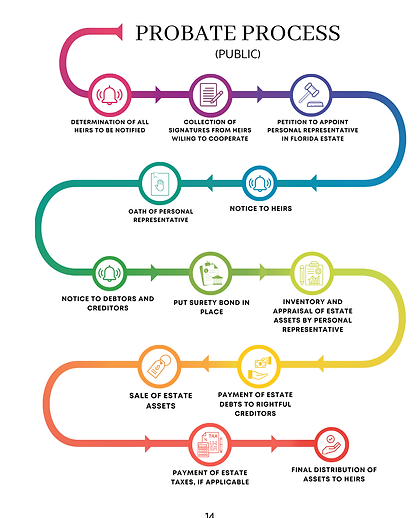
Probate is a legal process conducted through the court system, in one of the 67 different counties in Florida. It ensures that assets are transferred from the deceased’s name to the legal heirs or beneficiaries. You can learn more about probate from the Florida Courts Probate Guide.
Florida probate is generally also necessary to:


We know the probate process can raise many questions.
A free discovery call with our experienced team is the quickest and easiest way to get clear, personalized answers and understand exactly what your situation requires.
-
Prove the validity of a will through the probate court (Florida Statutes Chapter 733)
-
Appoint someone to manage the estate during probate
-
Take inventory and appraise estate property for estate process requirements
-
Pay the deceased’s debts and taxes as part of probate (Florida Department of Revenue)
-
Distribute estate property as directed by the will (or by Florida law if there is no will)
How Does Probate Begin?
Unless the estate qualifies for summary administration — either because it is small enough (non-exempt assets valued at $75,000 or less) or old enough (more than two years since the decedent’s passing) — formal administration will be required to complete the probate process.
Florida law determines who is entitled to initiate the probate process across the state (Florida Statutes §733.301):
-
The person with highest priority is the individual named in the deceased’s last will as the “executor” or “personal representative”, who is responsible for initiating court proceedings and moving the case to its completion.
-
If there is no will, or if the people nominated in the will are not available, Florida law establishes a hierarchy of eligibility, normally starting with a surviving spouse, then surviving adult children, and so on.
The individual with priority begins the probate process by working with an attorney. In most cases, a personal representative is not allowed to proceed pro se, meaning they cannot represent themselves in court. This is based on Florida Probate Rule 5.030(a).
Instead, a personal representative is typically required to have an attorney. Even in rare situations where self-representation may be allowed, it is still highly recommended to work with an experienced probate attorney. Probate is a complex legal process. Professional guidance helps ensure the case is handled correctly and efficiently.
The probate attorney typically:
-
Prepares and files court petitions
-
Handles inventories and creditor claims
-
Manages accountings and distribution plans
-
Prepares notices and final discharge documents
The attorney officially initiates the process by filing the original will with the probate court. Which court handles the probate case depends primarily on where the decedent lived at the time of their passing, although there are some exceptions. (Florida Statute § 733.101).
The best way to determine exactly what process applies is to meet with a probate attorney, serving clients all throughout the state, to review your circumstances and provide the best guidance.

Wondering whether your loved one’s estate can avoid formal administration?
Our team can help you find out quickly.
Schedule a free discovery call to get clear answers tailored to your situation.


Steps to Simplify the Probate Process
1
2
3
4
Work with an Experienced Probate Attorney
A skilled probate attorney guides you through every legal requirement and helps avoid delays or mistakes.
Understand the Timeline
Inheritance process can take months to over a year depending on the estate.
Keep Clear Records
Documentation prevents disputes and confusion.
Communicate Regularly
Regular updates to heirs and creditors reduce stress.
Going through probate after losing a loved one is difficult, here’s a clear, simple guide to Florida’s probate process.
Ready to simplify the probate process for your loved one’s estate?
The first step is often determining whether formal administration can be avoided.
Schedule a free discovery call with our team to get personalized guidance and clear next steps.
Looking for more information? Explore our Estate Planning & Probate Resource Hub for detailed guides, checklists, and FAQs to help you navigate each step with confidence.

Communication with Beneficiaries
There’s a modern reflection along the lines of, when families fight over inheritance, it’s rarely about wealth—it’s about wounds. People don’t battle for money; they battle for the last pieces of someone they loved. This reflects a timeless pattern where grief and money create a volatile mix that can fracture even the closest families.
But timeless doesn’t mean inevitable. Clear communication with heirs and beneficiaries is crucial to avoid or soften rifts in families after the passing of a loved one.

Types of Estate Administration


This proactive approach keeps the estate settlement process transparent and smoother for everyone involved.
-
Our attorneys ensure that all parties are informed of estate progress
-
This helps reduce misunderstandings and manage expectations
-
It also helps prevent or minimize potential conflicts among beneficiaries
Not all estates go through the same probate process. Florida law provides three main ways to administer an estate, depending on the size, complexity, and type of assets:
1
Formal Administration is the most common type for larger or more complex estates. It involves:
-
Filing a full probate petition with the court
-
Notifying all heirs and beneficiaries
-
Collecting and managing estate assets
-
Paying debts and taxes
-
Distributing property according to the will or Florida law
This process provides the highest level of court supervision and is often necessary when disputes or creditor claims may arise.
2
Summary Administration in Florida
Summary Administration is a simplified process for smaller estates. It is available if:
-
The value of the entire estate subject to administration in Florida, less the value of property exempt from creditors (such as homestead and certain personal property), does not exceed $75,000, or
-
The decedent has been deceased for more than two years (regardless of estate value)
Summary Administration typically requires less court involvement, is faster, and can reduce legal fees while still ensuring proper distribution of assets.
3
Disposition Without Administration in Florida
Disposition Without Administration is an informal option for very small estates. It applies only to estates that consist of personal property, not real estate. There must be no real property involved in the estate. This process is governed by Florida Statute §735.301.
It is typically used when the estate includes:
-
Exempt personal property
-
A small amount of non-exempt personal property
The non-exempt property is generally limited to covering:
-
Funeral expenses
-
Recent medical expenses
This option allows heirs or beneficiaries to receive assets without opening a full probate case. Because of this, it is usually much faster and simpler than formal probate administration.
Losing a loved one is hard enough—here's a straightforward timeline of the Florida probate process to help you know what to expect and when.

Estimated Timeline for Florida Probate:
Formal, Summary, and Disposition Without Administration

Are you sure which estate administration and settlement process applies to your loved one’s estate?
Choosing the right option can save time, reduce costs, and ensure compliance with Florida law.
If you’re unsure, our team can provide personalized guidance during a free discovery call.
Common Probate Mistakes to Avoid


Navigating probate can be complex, and mistakes can delay the process or create unnecessary costs. Here are some common mistakes and how our probate attorneys help you avoid them:
-
FILING INCORRECT DOCUMENTS — A probate attorney ensures all filings meet strict court requirements. Note that the Florida Courts do not provide official probate forms and strongly recommend consulting a probate attorney for guidance. (Florida Courts – Probate Resources)
-
PROCEEDING WITHOUT PROPER LEGAL REPRESENTATION – Many people underestimate how technical estate settlement rules are; working with a qualified probate attorney significantly reduces risk.
-
MISSING DEADLINES – Estate administration has strict deadlines; our attorneys track everything for clients across the state.
-
IGNORING ESTATE DEBTS – Proper estate administration ensures debts are settled correctly.
-
OVERLOOKING TAX OBLIGATIONS – Our attorneys help minimize tax issues during estate settlement.
-
FAILING TO COMMUNICATE WITH BENEFICIARIES – Regular updates prevent disputes and reduce litigation risk.


How Our Florida Probate Attorneys Can Help
At Tower Law Group, our Florida probate attorneys understand that estate settlement is more than paperwork—it’s an emotional journey for families. Our probate attorneys assist clients with:
-
Filing petitions and managing court requirements
-
Guiding beneficiaries, executors / personal representatives, and heirs
-
Handling creditor claims
-
Supporting surviving spouses
-
Resolving disputes or contested wills
-
Distributing assets efficiently under Florida law
Why Choose TOWER LAW GROUP for Florida Probate
When it comes to navigating probate, you want an experienced team you can trust. We offer:
-
Expertise: Over 20 years of experience including Florida probate and estate administration
-
Local Knowledge: Serving Orlando, Oviedo, and communities across the 67 counties in the state of Florida.
-
Personalized Service: Genuine and consistent human-to-human guidance through every step, minimizing stress and liability
-
Trust Administration Experience: We also handle trusts, often avoiding probate entirely (Florida Statutes Chapter 736 – Trusts)
-
Proven Reputation: Recognized by clients for professionalism, reliability, and results

A clear map of Florida highlighting all 67 counties, showcasing the probate service areas of Tower Law Group across the state.
With years of experience across the state, our attorneys provide compassionate guidance to help families focus on what truly matters.
Our team is here to guide you every step of the way.
Schedule a confidential, no obligation, free discovery call today.

Client Reviews
I highly recommend Tower Law Group as an outstanding probate attorney. Carina and her expert team especially Micaela has a deep understanding of probate law and handles each case with compassion, professionalism, and meticulous attention to detail. Carina and Micaela consistently guides clients through complex estate matters with clarity and empathy, making the process smoother during challenging times. I am confident that Tower Law Group will be a valuable advocate for anyone in need of expert probate legal assistance and expert in any other kind of legal issues. Thanks a lot for your support during our case, appreciated.
Vedat, former client
My family and I highly recommend the Tower Law Group for any probate proceedings and/or estate planning needs! Ms. de la Torre expertly guided us through my Mom’s probate and then worked with my husband and me to set up a trust for our children—so that they wouldn’t have to go through a probate action! The time and care she and her firm took with us made us truly feel heard and assured us they would do everything they could to protect our children in the future! The entire team was very responsive and answered all our questions thoroughly and quickly! We couldn’t be happier!!
Kim, former client
How Is the Personal Representative Chosen?
Under Florida law (Fla. Statute §733.301), the personal representative has a fiduciary duty to manage the estate responsibly, pay debts, and act in the best interest of beneficiaries. Understanding these duties early can prevent mistakes and disputes.
If a valid will exists, the executor or personal representative named typically oversees probate. Without a will, the law establishes priority among surviving family members.
Trust Administration
Properly funded trusts can often bypass probate. Our attorneys assist trustees with administration, ensuring compliance and minimizing liability across Orlando, Oviedo, and statewide. (Fla. Statutes Chapter 736 – Trusts)
Trusts can provide flexibility, avoid court supervision, and help maintain privacy, while also offering protection for minor children or beneficiaries with special needs. Our attorneys guide trustees through every step, ensuring the trust is administered correctly and in full compliance with Florida law.
Take the First Step Today
Navigating estate administration can feel overwhelming, but you don’t have to do it alone.
Our experienced probate team will guide you through every step, making the process as smooth and stress-free as possible.
Florida Probate For Real Estate


Are you dealing with real estate as part of a Florida probate case?
Property transfers during estate administration can be complex and must comply with strict legal requirements.
Our team can help you navigate the process and ensure a smooth transfer of real estate assets.
For more guidance, see probate for beneficiaries or probate for surviving spouse.
-
Inventory all real estate assets
-
Determine market value and appraisals
-
Complete legal transfer through probate court
-
Avoid delays and disputes
Real estate often requires probate if not held in a trust. We guide clients to:
Frequently Asked Questions (FAQs)


Want to dive deeper into probate and estate planning? Our Estate Planning & Probate Resource Hub has articles and resources to guide you through every option.
Trusted Florida Probate Attorneys
Led by Carina de la Torre, a highly experienced Florida probate attorney with over 20 years of experience, our team provides dedicated legal support to families, heirs, executors, and personal representatives navigating estate administration.
Together, our attorneys handle all aspects of Florida probate, including formal administration, summary (small estate) administration, and simplified probate processes throughout Florida—serving clients in Orlando, Oviedo, and communities across the 67 counties in Florida.
Carina and her team work collaboratively to streamline probate filings, ensure full compliance with Florida statutes, and reduce unnecessary delays and costs. From start to finish, we guide you through every stage of the process, including:


-
Asset identification and valuation
-
Creditor notifications and debt resolution
-
Court filings and legal compliance
-
Distribution of assets to heirs and beneficiaries
When applicable, our attorneys also help clients leverage ARAG legal coverage to minimize out-of-pocket expenses.
If you have ARAG coverage, click here to see how we can reduce your probate costs.
With Carina’s leadership and a team-based approach, you benefit from responsive communication, strategic guidance, and the collective experience of multiple probate attorneys dedicated to protecting your interests every step of the way.

Verified through the Florida Bar
Confidential, no-obligation discovery call
Experience in formal, summary, and simplified probate administration
Practical guidance for executors, personal representatives, heirs, and beneficiaries
Support for clients with ARAG coverage
Get answers. Gain clarity. Move forward.
Schedule your free discovery call today.

Planning ahead for the future?
Visit our Estate Planning page or join our upcoming educational events to learn how to avoid probate.
LEGAL REFERENCES AND SOURCES:
-
Fla. Statutes Chapter 732 – Intestate succession and beneficiary rights. Official Compilation, Florida Legislature.
-
Fla. Statutes Chapter 733 – Probate administration procedures, duties of personal representatives, and estate settlement. Official Compilation, FL Legislature.
-
Fla. Statutes §732.603 – Anti-lapse statute for beneficiaries. Official Compilation, FL Legislature.
-
Fla. Statutes §735.301 – Disposition without administration for small estates. Official Compilation, FL Legislature.
-
Florida Bar Association – Guidance on serving as a personal representative, estate administration, and probate.
-
Florida Courts – Probate Guide – Step-by-step instructions for estate administration and probate proceedings.