

FLORIDA PROBATE CREDITOR CLAIMS: Deadlines, Process & How to Protect Your Rights

Understanding Florida Probate Estate Debts
When a person passes away, their debts do not disappear. Instead, creditors must file a formal Statement of Claim against the estate during the Florida probate process. This allows them to request payment from the deceased person’s estate before any assets are distributed to beneficiaries or heirs.
The process protects both creditors and heirs. Creditors get a fair opportunity to collect what is owed, while the personal representative and beneficiaries are protected from late or unexpected creditor claims after distributions are made. Strict deadlines and procedural rules apply under Florida law.

Whether you are a claimant seeking repayment or a personal representative managing estate debts in Orlando, Oviedo, or in any of the 67 counties in Florida, knowing the rules surrounding estate debt submissions is critical. For more details, consult the Florida Bar guidance on debt petitions for official procedures.
The way debt filings are handled can vary depending on the estate type: Formal Administration, Summary Administration, and Disposition Without Administration.
Explore Other Related Probate Topics:
Return to our main Florida probate page for a full overview of the process.


Are you a creditor trying to understand how estate debts are handled in Florida probate?
Even when an estate settlement case is open, strict deadlines and legal procedures can affect your ability to recover what you’re owed. Our team can help you understand your rights, evaluate your claims, and take the necessary steps to protect your interests. Schedule your free discovery call today.

What Are Probate Creditor Claims?
A creditor claim (also called a Statement of Claim) is a formal written filing submitted to the court. It notifies the court and the personal representative that the estate owes a debt.
Common examples include:
-
Credit card balances
-
Medical bills and hospital expenses
-
Personal or business loans
-
Utility bills
-
Unpaid rent or mortgage obligations
-
Contractor or service invoices
-
Funeral or burial expenses advanced by another person
Each claim must include proper supporting documentation. Without sufficient proof, the personal representative may reject the claim. See Fla. Stat. §733.703 for filing requirements.

The Florida Probate Debt Process
In a formal administration, the process follows a clear legal framework under Chapter 733:
1
2
Opening the Estate
The court appoints a personal representative to administer the estate and handle estate debt filings.
Notice to Creditors (§733.2121)
The personal representative must send direct notice to known creditors and publish a Notice to Creditors in a local newspaper for unknown claimants. This starts the clock for filing petitions.
3
Filing the Statement of Claim (§733.703)
Claimants must file a formal Statement of Claim with the court, including the amount owed, the basis of the claim, and supporting documentation.
4
5
Review by the Personal Representative
The personal representative reviews each claim and decides whether to accept it, pay it, or object to it.
Payment or Dispute
Approved filings are paid according to statutory priority. Rejected filings may require the claimant to file a lawsuit within the allowed time or risk having their claim barred.
Are you a creditor unsure how the probate debt process works?
Deadlines and procedures can affect your ability to recover what you’re owed. Our team can help you protect your claim. Schedule your free discovery call today.
Deadlines for Florida Estate Creditor Claims
Deadlines are one of the most critical aspects of estate debt petitions. Missing a deadline can result in losing the right to collect the debt entirely.
Claims must be filed on or before the later of:
-
3 months after the first publication of the Notice to Creditors (this applies to all claimants, including unknown or not reasonably ascertainable ones), or
-
30 days after the date of service of the Notice to Creditors on that claimant (this applies specifically to known or reasonably ascertainable claimants who are required to be served with direct notice under Florida law).
There is also a 2-year statute of repose (§733.710) from the date of death, after which virtually all filings are barred regardless of notice. However, under Jones v. Golden, 176 So. 3d 242 (Fla. 2015), a known or reasonably ascertainable creditor who was never served with the Notice to Creditors may file anytime within those 2 years (provided the claim is still filed before the 2-year bar expires). The claim must still comply with all other procedural requirements.
⚠️ CRITICAL: If you miss the applicable deadline, your claim will be permanently barred, even if the debt is valid. Acting quickly is essential. For the exact statutory language, see Fla. Stat. §733.702.
A step-by-step timeline of Florida probate to guide personal representatives through the process.


Are you concerned about missing important deadlines in Florida probate?
Strict time limits can determine whether your claim is accepted or barred. Our team can help you act quickly and protect your rights. Schedule your free discovery call today.




How to File a Creditor Claim
Filing a Statement of Claim involves more than simply submitting a bill. It must meet legal requirements under Florida probate rules.
Steps to File Properly:
1
2
Prepare a written statement of claim
Include all supporting documentation (contracts, invoices, statements)
3
File the claim with the probate court handling the estate
4
Ensure the claim is filed within the applicable deadline
Common Filing Mistakes to Avoid:
-
Submitting incomplete documentation
-
Filing in the wrong court
-
Missing the deadline
-
Failing to clearly state the basis of the submission
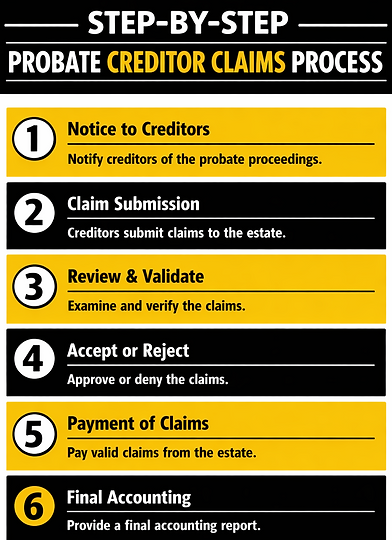
Your roadmap for submitting and resolving estate debts in Florida probate.
Proper filing increases the likelihood that your submission will be accepted and paid. For detailed filing guidance, see Florida Bar probate resources.
Are you a creditor unsure how to properly file a claim in Florida?
Filing errors or missed steps can delay—or even prevent—recovery of what you’re owed. Our team can guide you through the process to help protect your claim. Schedule your free discovery call today.

What Happens After a Submission Is Filed?
After filing, the personal representative reviews the claim and decides whether to allow or object to it.
If the Claim Is Allowed (or Not Timely Objected To): The claim is considered allowed. The personal representative must pay all allowed filings within 1 year from the first publication of the Notice to Creditors (§733.705), according to the statutory priority and available assets. However, the personal representative cannot be forced to make payments until 5 months after the first publication of the Notice.
If the Claim Is Rejected: The personal representative or other interested person must file a written objection no later than the later of:
-
4 months from the first publication of the Notice to Creditors, or
-
30 days after the claim was timely filed or amended.
The objection must also be served on the creditor (or the creditor’s attorney). Failure to properly serve a copy of the objection on the claimant constitutes an abandonment of the objection, meaning the claim is treated as allowed.
The creditor then has 30 days from the date the objection is served to file an independent lawsuit to prove the claim in the appropriate court. Failure to file the lawsuit within this 30-day window usually bars the claim permanently.
Claims in litigation, unmatured, or contingent claims may receive additional time as needed. The court may grant extensions for good cause.
Are you wondering what happens after filing a creditor claim in Florida?
Once submitted, your claim must go through review, potential objections, and court procedures that can affect your recovery. Our team can help you understand the process and what to expect next. Schedule your free discovery call today.

Payment Priorities for Estate Debts
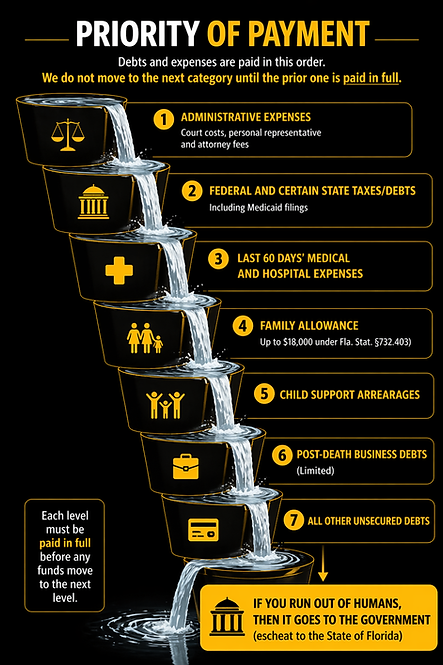
Florida law (§733.707) requires debts to be paid in a specific order. Here is the simplified priority:
4
7
3
6
2
5
1
Administrative expenses (court costs, personal representative and attorney fees)
Reasonable funeral, interment, and grave marker expenses, not to exceed $6,000
Federal and certain state taxes/debts (including Medicaid filings)
Last 60 days’ medical and hospital expenses
Child support arrearages
Family allowance (a reasonable amount for the maintenance of the surviving spouse and dependent lineal heirs the decedent was supporting — up to a maximum of $18,000 under Fla. Stat. §732.403)
Post-death business debts (limited)
All other unsecured debts
8
If assets are insufficient, higher-priority classes are paid first (or pro-rata within the same class). Secured claimants generally have separate rights to their collateral. Any funeral expenses above the $6,000 limit are treated as general unsecured claims.
Understand the order in which debts are paid during Florida probate.


Are you unsure how estate debts are prioritized in Florida probate?
Not all claims are treated equally, and payment order can affect whether and how much you recover. Our team can help you understand where your claim stands. Schedule your free discovery call today.
Disputing Estate Debt Filings
Disputes on alleged debts or creditor claims are common in probate, especially when a proof of claim or statement of claim is unclear, inflated, or unsupported.
A personal representative may object to a claim if:
-
The amount is incorrect
-
The debt is not valid
-
Documentation is insufficient
-
The claim was filed late
What creditors should do if their petition is disputed:
-
Review the objection carefully
-
Gather additional evidence
-
File a legal action within the required timeframe
Disputes can become complex, and legal guidance is often necessary. For assistance, consult the Florida Bar probate guidance.

Common Challenges with Estate Debt Filings
Handling debt filings is not always straightforward. Some common challenges include:
-
Missed deadlines – one of the most frequent reasons submissions are denied
-
Insufficient documentation – weak submissions are often rejected
-
Disputes with the estate – disagreements over validity or amount
-
Limited estate assets – not all claimants may be paid
-
Complex estates – business interests or multiple properties complicate petitions
Understanding these issues early helps both debt holders and personal representatives avoid costly mistakes.
Are you facing delays, disputes, or other challenges with a Florida probate creditor claim?
Issues like claim objections, missing documentation, or procedural errors can affect your ability to recover. Our team can help you navigate and resolve common filing challenges. Schedule your free discovery call today.
Tips for Debt Holders to Protect Their Petitions
If you are a debt holder, taking proactive steps can significantly improve your chances of recovery:
-
File a caveat with the court to ensure you receive notice
-
Act immediately upon receiving notice
-
Monitor estate settlement filings and deadlines
-
Keep complete and organized records
-
File claims accurately and on time
-
Respond quickly to objections
-
Seek legal guidance for complex filings
-
Open a probate if needed to ensure payment
Tips for Personal Representatives Managing Submissions
If you are administering an estate, you must handle submissions carefully to avoid liability:
-
Provide proper notice to creditors
-
Review submissions thoroughly
-
Keep detailed records of all decisions
-
Follow statutory payment priorities
-
Avoid paying petitions prematurely
-
Consult your probate attorney when needed
Failure to follow proper procedures can result in personal liability for the representative. See Fla. Stat. §733.603 for personal representative duties.
Are you dealing with estate debt claims in Florida probate?
Whether you’re filing a claim or managing submissions, mistakes can lead to delays, disputes, or loss of rights. Our team can help you stay compliant and protect your position in the process. Schedule your free discovery call today.

My experience was amazing. All my questions were answered with professionalism and kindness. They have a level of integrity that is impressive. I highly recommend Tower Law Group.
Lisa, former client
Frequently Asked Questions (FAQs)

How a Florida Probate Attorney Can Help
A probate attorney plays a critical role in handling creditor claims. Legal guidance can help:
-
Ensure statement of claim or proofs of claim are filed correctly and on time
-
Respond to objections and disputes
-
Navigate complex estate administration procedures
-
Protect financial interests for creditors or estates
-
Minimize delays and legal risks
Whether you are filing a claim or managing estate debts in Orlando, Oviedo, or anywhere across the 67 counties, professional assistance can make the process smoother and more efficient. Navigating estate debts is a critical part of the overall probate process. For authority guidance, see Florida Bar probate resources.


Trusted Florida Probate Attorneys for Creditors
Led by Carina de la Torre, a Florida probate attorney with over 20 years of experience, our team helps creditors, estates, and personal representatives navigate the probate process.
We specialize in managing estate debts, meeting strict deadlines, and ensuring compliance with Florida law across Orlando, Oviedo, and surrounding communities.
Our team works closely with creditors to protect their rights, verify claims, and pursue collection efficiently, while also guiding personal representatives through proper notifications and distributions to minimize disputes.
Our practical, hands-on approach ensures claims are handled accurately and timely, reducing stress for all parties involved.


Verified through the Florida Bar
Expertise in probate creditor claims and estate administration
Guidance for creditors, personal representatives, and heirs
Support for clients with ARAG coverage
See how ARAG coverage can help creditors file claims efficiently.
If you need help with Florida estate debt claims, our experienced probate attorneys are here to guide you. We assist both creditors and personal representatives in navigating the estate settlement process efficiently and in compliance with the law.
-
Confidential, no obligation, free discovery call
-
Guidance on filing and enforcing outstanding debts


-
Support for disputes and complex estates
LEGAL REFERENCES AND SOURCES:
-
Fla. Stat. §733.702 – Limitations on presentation of claims (filing deadlines for estate debts).
-
Fla. Stat. §733.703 – Form and manner of presenting claim (requirements for Statement of Claim).
-
Fla. Stat. §733.705 – Payment of and objection to claims (objection process and payment rules).
-
Fla. Stat. §733.707 – Order of payment of expenses and obligations (statutory payment priorities).
-
Fla. Stat. §733.710 – Limitations on claims against estates (2-year statute of repose).
-
Fla. Stat. §733.2121 – Notice to creditors (requirements for direct notice and publication)