


What is Summary Administration in Florida?

Summary Administration in Florida is a simplified probate procedure for smaller or uncomplicated estates. Under Florida law (primarily Florida Statutes §§ 735.201–735.2063), it allows eligible estates to bypass the more formal, court-supervised probate process. This reduces time, paperwork, and costs compared to formal administration.
The process is available when the value of the estate subject to administration in Florida (less exempt property) does not exceed $75,000, or when the decedent has been deceased for more than two years. No personal representative is formally appointed in summary administration. Instead, the court can directly order distribution of assets to the proper beneficiaries or heirs.
This streamlined option helps families settle estates efficiently while complying with Florida probate law. It is not legal advice — consult a licensed Florida probate attorney for your specific situation. For official details, refer to the Florida Courts probate forms and statutes.
Learn more about how this impacts heirs in our Probate for Beneficiaries guide, or explore our Florida Probate Overview guide.


Have questions about whether Summary Administration is the right probate option for your situation in Florida?
Understanding whether you qualify and how to move forward can make a big difference in saving time, cost, and stress for your family.
When is Summary Administration in Florida Available (or Permitted)?
Florida law permits simplified probate if one of the following applies (Fla. Statute §735.201):
-
The value of the entire estate subject to administration in this state, less the value of property exempt from the claims of creditors (such as homestead and certain personal property), does not exceed $75,000; or
-
The decedent has been deceased for more than two years.
i
IMPORTANT UPDATE ON THRESHOLD CHANGE: Legislation passed in 2026 (CS/HB 1337) will increase the threshold from $75,000 to $150,000, effective July 1, 2026. The information above reflects the law as of March 30, 2026. After July 1, 2026, please check the current version of Florida Statute §735.201 or consult a probate attorney for the updated limit.
Additional practical considerations include:
-
The decedent’s will (if any) does not direct formal administration under Chapter 733.
-
There are no significant disputes among heirs or beneficiaries that would require more formal proceedings.
Estates that do not meet these criteria, or that involve complex assets, disputes, or other complications, generally require formal administration instead.
Only assets that would normally pass through probate count toward the $75,000 limit. Non-probate assets (such as jointly owned property with right of survivorship or assets with payable-on-death beneficiaries) are typically excluded.
Step-by-Step Process
1
Filing the Petition

Any beneficiary or person nominated as personal representative in the will may file a verified Petition for Summary Administration with the appropriate circuit court probate division (venue is usually the county of the decedent’s domicile). Any beneficiary or person nominated as personal representative in the will may file a verified Petition for Summary Administration with the appropriate circuit court probate division (venue is usually the county of the decedent’s domicile).
The petition must include (per Florida Probate Rule 5.530):
-
Details about the decedent (name, date/place of death, last 4 digits of SSN, domicile).
-
Names and addresses of the surviving spouse (if any), heirs, and beneficiaries, including their relationship to the decedent.
-
A statement confirming eligibility for small estate probate.
-
A description of all probate assets and their estimated values, plus a separate listing of any protected homestead and exempt property.
-
Information about creditors (either that claims are barred, a diligent search was made and none exist, or details of known creditors with provision for payment).
-
The proposed distribution of assets.
-
A copy of the will, if one exists.
2
Notice to Interested Parties
Petitioners must serve formal notice of the petition on all known beneficiaries, heirs, and (if applicable) known or reasonably ascertainable creditors. If the decedent has been dead more than two years, most creditor claims are generally barred under Florida Statute §733.710.
3
Payment of Debts and Expenses
Before or as part of the distribution, the estate must address valid debts. Priorities generally follow statutory order (e.g., funeral expenses, taxes, secured debts). In small estate probate, this is often handled by providing for payment in the petition and order.
4
Distribution of Assets
If the court approves the petition, it enters an Order of Summary Administration that authorizes direct distribution of the remaining assets according to the will (if any) or Florida intestacy laws. The process typically concludes with this order, without the need for a full formal accounting or appointment of a personal representative. The entire process is usually completed in a few weeks to a few months for uncontested cases.
This process is handled efficiently by the probate courts serving Orlando/Lake Nona, Oviedo, Daytona Beach, Miami, and across the 67 counties in Florida.
Learn more about your rights as a surviving spouse in our Surviving Spouse guide.


A step-by-step guide to completing summary (small estate) administration in Florida.
Ready to understand how Summary Administration works step by step in Florida?
If you’re trying to figure out what comes next in the process—and what you’ll need to do at each stage—we can walk you through it clearly and help you avoid costly delays.



How Summary Differs from Formal Probate
1
Estate Size and Eligibility
Summary: Available if probate assets (less exempt property) ≤ $75,000 or decedent deceased > 2 years
Formal: Required for larger estates or when summary criteria are not met. No value or time threshold.
2
Court Involvement & Personal Representative
Summary: Minimal oversight. No formal personal representative is appointed. The court can issue a distribution order directly.
Formal: Requires appointment of a personal representative, more detailed filings, and potentially multiple court hearings.
3
Time and Costs
Summary: Often completed in 1–3 months with lower costs and less paperwork.
Formal: Typically takes 6–18 months (or longer) with higher legal and court expenses.
4
Creditor Handling
Summary: Simplified. Creditor claims are often barred after 2 years (Florida Statute §733.710). For estates under the $75,000 threshold, known creditors must still be addressed via diligent search and notice.
Formal: Requires formal notice to creditors and a structured claims period (usually 3 months after publication or notice).
5
Complexity
Summary: Best for straightforward estates with clear ownership, no disputes, and limited assets.
Formal: Necessary for complex assets, potential disputes, or when more oversight is needed.
Summary probate offers a faster, simpler, and more cost-effective probate route for eligible estates. Formal administration, while more comprehensive, is designed to handle complex situations that require careful oversight under Florida probate law.

A clear comparison of summary administration and formal probate in Florida.

Wondering how summary administration differs from formal probate in Florida, and which one applies to your situation?
The differences can significantly impact timelines, costs, and required court involvement, so it’s important to understand which path fits your case.

Key Deadlines in Summary Probate
Petition filing:
Can be filed as soon as the estate qualifies (no strict deadline but sooner is generally better).
Creditor notice and claims:
For deaths less than 2 years ago, a diligent search for creditors is required. Known creditors must receive formal notice. Claims are generally barred 2 years after death under Fla. Statute §733.710 (with limited exceptions for recorded liens, etc.).
Distribution and closing:
Once the court enters the Order of Summary Administration, assets can be distributed promptly. No formal final accounting is usually required unless the court directs otherwise.
Missing deadlines or failing to provide proper notice can delay the case or expose recipients to limited personal liability for unpaid debts up to the value of assets received.
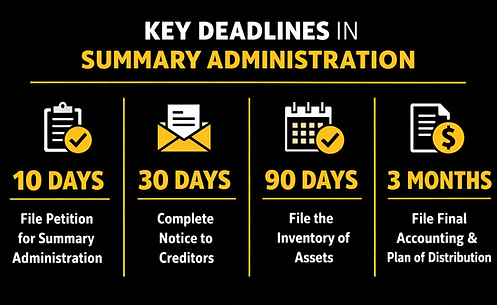
Concerned about missing key deadlines in a Florida Summary Administration case?
Probate timelines can affect eligibility, court approval, and how quickly assets are distributed, so it’s important to know what applies in your situation.
A guide to the important deadlines in Florida summary administration
Benefits
-
Faster and less expensive than formal administration
-
Simplifies estate settlement for heirs and beneficiaries
-
Reduces court involvement and paperwork
-
Protects heirs and beneficiaries from procedural mistakes
Challenges
Even in small estate probate, potential issues include:
-
Incorrect valuation of assets or misunderstanding what counts toward the $75,000 threshold (only non-exempt probate assets).
-
Failure to conduct a proper diligent search for creditors.
-
Disputes among beneficiaries or heirs that may require conversion to formal administration.
-
Complex assets (e.g., real estate, businesses) that need accurate valuation or title work.
-
Missing or invalid wills that complicate distribution.
Tips for Personal Representatives (or Petitioners)
Although no personal representative is formally appointed in summary administration, the petitioner(s) should:
-
Maintain detailed records of all assets, debts, and communications.
-
Conduct a thorough search for creditors and document it.
-
Accurately list and value all probate assets (separately identifying homestead and exempt property).
-
Communicate clearly with all heirs and beneficiaries to avoid disputes.
-
Include a clear proposed schedule of distribution in the petition.
-
Consider consulting a Florida probate attorney to ensure compliance and avoid personal liability risks.
Have additional probate questions?
Browse our Estate Planning & Probate Resource Hub for educational resources covering probate administration, estate planning, wills, trusts, beneficiary rights, and related Florida probate topics.



How a Florida Probate Attorney Can Help
An experienced probate attorney can:
-
Ensure your estate qualifies for summary administration
-
Guide you through filing and creditor notifications
-
Assist with asset valuation, tax obligations, and distributions
-
Help resolve disputes efficiently
-
Protect heirs and representatives from personal liability
Local expertise in Orlando, Oviedo, and throughout the 67 Florida counties ensures smoother filings and faster resolution.
Looking for an Office Near You?
Our team assists families throughout Florida with summary administration (small estate probate), helping simplify the legal process after the loss of a loved one. We provide personalized guidance across our office locations and surrounding communities.
If you’re looking for help near you, explore our local offices below:
Oviedo Office – Helping families and beneficiaries throughout Central Florida, including Seminole, Orange, Brevard, Lake, and Polk counties, determine if their estate qualifies for summary administration and guiding them through the simplified process.
Lake Nona Office – Convenient support for families in Osceola County and surrounding South Orange County communities seeking a faster, more affordable alternative to formal probate through summary administration.
Daytona Beach Office – Local guidance for families in Daytona Beach and Volusia County pursuing summary administration for smaller or qualifying estates.
Miami Office – Dedicated support for families and beneficiaries in Miami and Miami-Dade County navigating summary administration and expediting estate distribution.
Handling a small estate?
Speak with a Florida probate attorney today to avoid costly mistakes.
Frequently Asked Questions (FAQs)

Carina is awesome very thorough and specific in detail. She gets to know you and your family life to ensure she guides you down the right path. I would whole heartily recommend tower law group to all my friends any day of the week. Kevin was great he response quickly to questions and is very detail in his reply and made the process understandable and easy.
Carolyn, former client
Want to make things easier for your loved ones someday?
Attend one of our upcoming estate planning events to learn how wills, trusts, powers of attorney, and other planning tools can help protect your family and reduce future probate complications. View Upcoming Events.
Trusted Florida Probate Attorneys
Led by Carina de la Torre, a seasoned Florida probate attorney with over 22 years of experience helping families, heirs, and personal representatives navigate summary (small estate) administration, our team guide clients through simplified probate procedures, handling court filings, creditor notices, and asset distribution across Orlando, Oviedo, and surrounding communities in 67 counties statewide.
We work closely with clients, including those with ARAG coverage, to reduce out-of-pocket costs while ensuring small estates are administered accurately, efficiently, and in compliance with Florida law. Our practical, hands-on approach minimizes stress and helps families focus on what matters most.


Verified through the Florida Bar
Expertise in summary (small estate) administration
Guidance for personal representatives, heirs, and families
Confidential, no obligation, free discovery call
Support for clients with ARAG coverage

LEGAL REFERENCES AND SOURCES:
-
Fla. Stat. §§ 735.201–735.2063 — Summary Administration (nature of proceedings, eligibility, petition requirements, and procedures).
-
Fla. Stat. § 733.710 — Limitations on claims against estates (two-year creditor claims bar).
-
Florida Probate Rule 5.530 — Summary Administration (contents of the petition).
-
Florida Courts – Probate Information and Forms (flcourts.gov).
-
CS/HB 1337 (2026) — Legislation increasing the summary administration threshold from $75,000 to $150,000, effective July 1, 2026.