

DISPOSITION WITHOUT ADMINISTRATION FLORIDA: Step-by-Step Guide

What is Disposition Without Administration?
Disposition Without Administration (also called disposition of personal property without administration) is the simplest and fastest way to handle a very small estate in Florida. Under Fla. Statute §735.301, no formal probate process or court-supervised proceedings are required when the decedent leaves only certain personal property.
This process allows interested parties (usually family members or those who paid final expenses) to ask the court to authorize the transfer or payment of assets directly—often through a simple informal application or petition. It is ideal for tiny estates with no real estate and minimal non-exempt personal property.
KEY BENEFIT: It avoids the time, cost, and paperwork of summary administration or full formal probate. The court can issue a letter or order under its seal authorizing banks, financial institutions, or others to release the property.

This applies only to personal property (bank accounts, vehicles, household goods, etc.). Real estate always requires probate.
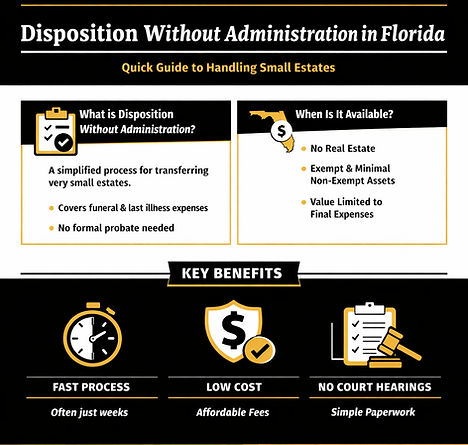
A quick guide to handling small estates in Florida through informal estate transfer.
Looking for a simple way to handle a small estate without going through full probate?
If your situation involves limited assets and you want a faster, more cost-effective process, Disposition Without Administration may be the solution.
Schedule a free discovery call with our team to find out if you qualify and what steps to take next.


When is this Process Available?
Florida law permits this process if the estate meets these strict criteria (Fla. Stat. §735.301):
-
The decedent left only personal property (no real estate or homestead to probate).
-
The estate consists of:

Personal property exempt under Fla. Stat. §732.402 and the FL Constitution (e.g., certain household furnishings, clothing, up to two vehicles in some cases).
Plus non-exempt personal property whose value does not exceed the sum of:
-
Preferred funeral expenses, and
-
Reasonable and necessary medical and hospital expenses of the last 60 days of the decedent’s final illness.
IMPORTANT UPDATE ON THRESHOLD CHANGE:
Legislation passed in 2026 (CS/HB 1337) will increase the threshold from $75,000 to $150,000, effective July 1, 2026. The information above reflects the law as of March 30, 2026. After July 1, 2026, please check the current version of Florida Statute §735.201 or consult a probate attorney for the updated limit.
i
-
There is generally no strict dollar cap beyond covering final expenses, but the non-exempt portion must be very limited.
-
For intestate (no will) small estates, a related provision (§735.304) allows informal estate transfer if non-exempt personal property does not exceed a set amount plus final expenses (increasing from $10,000 to $20,000 effective July 1, 2026 under CS/HB 1337).
Estates with real property, larger non-exempt assets, or disputes generally require summary administration or formal administration instead.
Only probate assets count. Jointly owned property with right of survivorship or payable-on-death accounts usually pass outside this process.
If you are a surviving spouse and want to understand your rights and options under Florida probate law, visit our Probate for Surviving Spouses page for guidance.
Step-by-Step Process
1
Confirm Eligibility
Verify the decedent left no real estate and that non-exempt personal property value is limited to final funeral + last-60-days medical expenses. Gather proof of all expenses.
2
Prepare the Application/Petition
Any interested party (e.g., surviving spouse, heir, or person who paid expenses) can file an informal application by:


Follow these four easy steps to manage small estates with no formal administration.
-
Affidavit
-
Letter
-
Or a formal verified petition (most counties provide a specific form)
The filing must include:
-
Decedent’s details (name, date/place of death, domicile, last 4 digits of SSN)
-
Description and value of all personal property (exempt and non-exempt)
-
Itemized funeral and medical expenses with receipts/proof of payment
-
Names and addresses of heirs/beneficiaries and their relationship to the decedent
-
Proposed distribution or reimbursement (e.g., reimburse the person who paid bills first)
-
Copy of the will, if one exists
-
Statement regarding creditors (diligent search made, or claims are barred)

If you are a creditor or need to understand creditor claims in probate, see our Probate for Creditors page for deadlines, procedures, and protections.
3
File with the Court
File in the probate division of the circuit court in the county where the decedent lived (venue). Include a certified death certificate and pay the filing fee (varies by county, often around $200–$300).
4
Court Review and Order

If the court is satisfied, it issues a letter or order under the seal of the court authorizing the transfer or payment of the assets. No formal hearing is usually required. Banks or institutions must then release the property and are protected from liability.
The entire process can often be completed in a few weeks for straightforward cases.
This process is handled efficiently by the probate courts serving Orlando, Oviedo, and surrounding communities.
For estates that require a personal representative, visit our Probate for Personal Representative guide for detailed instructions and timelines.
Not sure if your loved one's estate qualifies for disposition without administration?
Book a free discovery call and we'll walk through your situation together.



How This Informal Estate Process Differs from Other Probate Options
-
Disposition: No formal proceedings; for the smallest estates with only personal property; fastest and cheapest; no personal representative appointed. It is the quickest route when the estate is truly minimal and covers only final expenses
-
Summary (Small Estate Probate): Simplified but still involves a petition and court order; available up to $75,000 (rising to $150,000 July 2026) or after 2+ years; can include more assets.
-
Formal (Full): Required for larger, complex, or disputed estates; appoints a personal representative (executor); longer timeline and higher costs.
Learn more about Summary Administration for slightly larger estates.
Learn more about Formal Administration for complex situations.
Key Deadlines and Practical Tips
-
File as soon as possible after gathering documents. There is no strict deadline, but prompt action helps.
-
Include proof of all paid expenses.
-
Conduct a diligent search for creditors if needed.
-
Keep detailed records and receipts.

-
Organize all bills and asset statements.
-
Communicate with family members to avoid disputes.
-
Consider consulting a probate attorney if the estate has any complications.
Worried about missing a deadline for disposition without administration?
Book a free discovery call and we'll confirm your timeline and next steps.
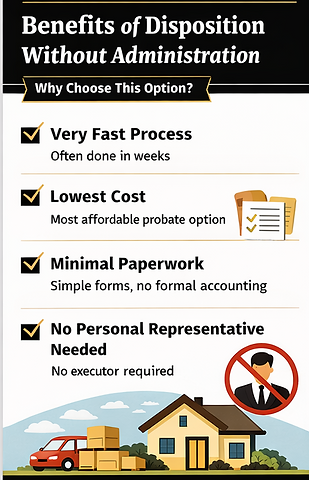
Benefits of This Simplified Process
-
Extremely fast (often weeks, not months)
-
Minimal court involvement and paperwork
-
Lowest cost option
-
No personal representative or formal accounting required
-
Protects those who paid final expenses by allowing reimbursement
Discover the key benefits of disposition outside administration.
Common Challenges


-
Real estate automatically disqualifies the estate.
-
Miscalculating exempt vs. non-exempt property.
-
Missing receipts for funeral or medical expenses.
-
Disputes among heirs can force a switch to summary or formal probate.
How a Florida Probate Attorney Can Help
An experienced probate attorney can:
-
Confirm eligibility for this simplified procedure
-
Prepare and file the petition or affidavit correctly
-
Handle asset valuation and creditor issues
-
Ensure proper distribution and protect against liability
-
Advise if you should use simplified probate instead
Local expertise in Orlando, Oviedo, and surrounding communities throughout the 67 counties in Florida ensures smoother filings and faster resolution.
Looking for an Office Near You?
We offer in-person consultations by appointment at our Oviedo office, as well as satellite meeting locations in Lake Nona, Daytona Beach, and Miami—plus virtual appointments for clients anywhere in Florida.
Oviedo Office – Your local team for disposition without administration, helping Seminole County families with small estates reimburse final expenses without the cost and delay of full probate.
Lake Nona Office – Convenient support for residents in Osceola County and surrounding South Orange County communities pursuing disposition without administration.
Daytona Beach Office – Local guidance for families in Daytona Beach and Volusia County navigating disposition without administration for small estates.
Miami Office – Dedicated support for Miami and Miami-Dade County families seeking a simplified path through disposition without administration.
Handling a very small estate?
Speak with a probate attorney today to avoid delays.

Frequently Asked Questions (FAQs)
Looking for more answers on probate?
Visit our Estate Planning & Probate Resource Hub, packed with educational resources on probate administration, estate planning, wills, trusts, beneficiary rights, and related Florida probate topics.

Had the opportunity to work with Tower Law Group. Carina and Kevin have been amazing. The patience, knowledge and willingness to walk us thru the entire process has helped ease our nerves and put us in a position where we feel secure and confident with the steps we have taken. Thank you.
Claudia, former client
Trusted Florida Probate Attorneys
Led by Carina de la Torre, a Florida probate attorney with over 20 years of experience helping families and heirs handle estates through disposition without administration. Our attorneys guide clients in transferring personal property outside formal probate, ensuring compliance with the law while making the process simple and efficient across Orlando/Lake Nona, Oviedo, Daytona Beach, Miami, and surrounding communities throughout the 67 counties in the state of Florida.
Our team works closely with clients, including those with ARAG coverage, to minimize out-of-pocket costs while ensuring transfers are handled accurately and with minimal stress. Our practical approach helps families focus on what matters most.


Verified through the Florida Bar
Expertise in disposition without administration
Guidance for personal representatives, heirs, and families
Confidential, no obligation, free discovery call
Support for clients with ARAG coverage

Want to spare your family stress and confusion later on?
Attend an upcoming estate planning event to discover how proper planning with wills, trusts, and powers of attorney can simplify things when it matters most. View Upcoming Events.
LEGAL REFERENCES AND SOURCES:
-
Fla. Stat. §735.301 — Disposition without administration.
-
Fla. Stat. §735.304 — Transfer of intestate property without administration in small estates
-
FL Probate Rule 5.420 — Handling of personal property without administration
-
CS/HB 1337 (2026) — Updates to small estate thresholds effective July 1, 2026.
-
Florida Courts – Probate Information (flcourts.gov).